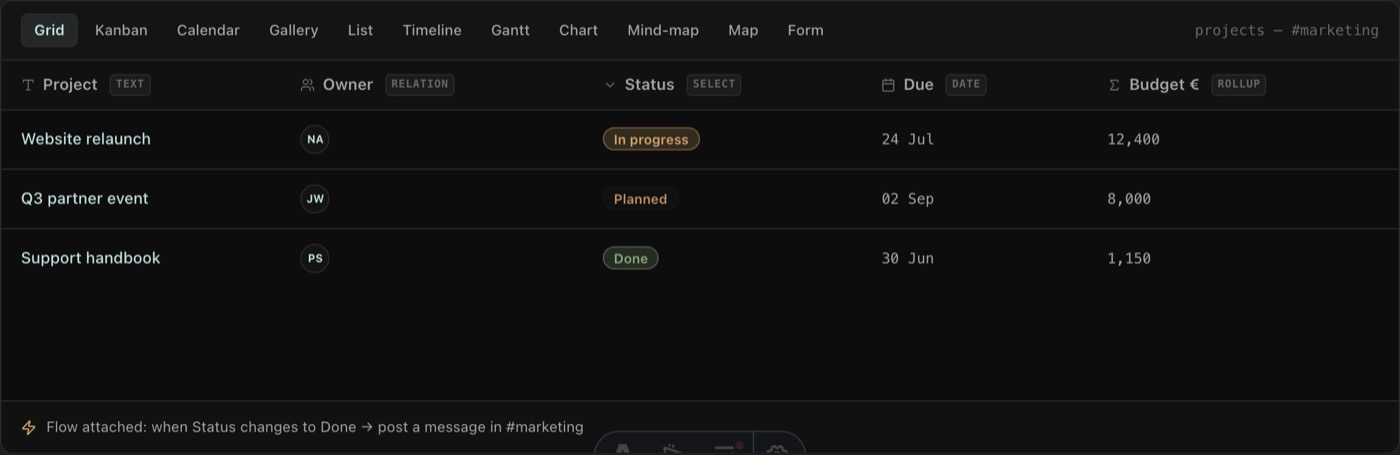
Tables, the database module that lives inside Polybase channels, has a major update: one table now renders as eleven views — grid, kanban, calendar, gallery, list, timeline, Gantt, chart, mind-map, map and form — alongside CSV import with inferred column types and a new ER-diagram view of your schema.
Structured data usually lives one tool away from the people discussing it: a status changes in the spreadsheet, the conversation happens somewhere else, and the two drift apart. In Polybase, a table is part of the channel — the grid, the chat about it and the tasks it drives share one place and one set of permissions.
Getting data in, and back out, is deliberately unceremonious. Drop in an Excel, CSV or ODS file and column types are inferred automatically; any view exports back to CSV, so nothing you build here is locked in. The ER-diagram view draws your tables and the relations between them — the first thing anyone asks for once linked records span more than two tables.
Under the grid, the database is real: 16 typed column types with validation, required and unique rules; linked records across tables; formulas, lookups and rollups computed and stored server-side so views stay fast. Per-row permissions control who sees and edits what, and every table is a trigger surface for Flows — a new or changed row can start a workflow.
Like every Polybase module, Tables ships in cloud, private-cloud and self-hosted deployments. Teams that run Polybase on their own servers keep their structured data exactly where the rest of their workspace already lives.
- 11 views on one table: grid, kanban, calendar, gallery, list, timeline, Gantt, chart, mind-map, map and form
- Excel, CSV & ODS import with type inference — any view exports back to CSV
- ER-diagram view of your schema and its relations
- 16 typed column types; formulas, lookups and rollups computed server-side
- Per-row permissions and row triggers into Flows